By Middle East Correspondent
LONDON, (The Muslim News): At least 49 people were killed in a series of Israeli airstrikes across the Lebanese capital Beirut and the country’s south on Sunday, according to Lebanon’s health ministry and local media, as the widening conflict involving Israel, the United States and Iran continues to push the region towards a broader war.
Lebanese officials had earlier reported that nearly 400 people had been killed since Israel expanded its military campaign in Lebanon last Monday. The latest strikes are therefore likely to push the death toll well beyond 400, while more than 1,100 people have been injured and thousands displaced.
The attacks came a day after at least 55 people, including children, were killed in Israeli airstrikes across eastern and southern Lebanon on Saturday.
Deadly strikes across southern Lebanon
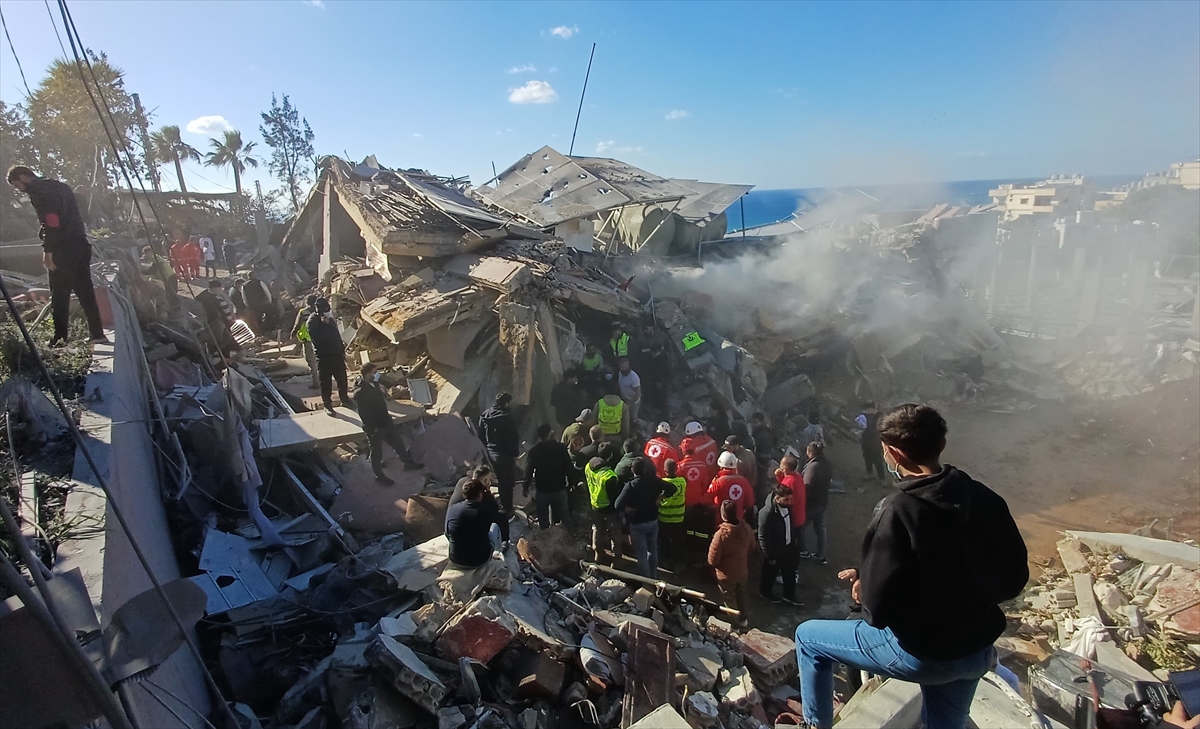
One of the deadliest attacks on Sunday struck the town of Seir el-Gharbiya in Nabatieh governorate, where Israeli warplanes hit a three-storey building, killing 19 people, most of them women and children, according to the Lebanese health ministry.
Elsewhere in the south, four people were killed in an airstrike on the town of Qana in the Tyre district, while two others died in a strike on Ghazieh near Sidon. Earlier, the ministry reported that eight people, including five members of the same family, were killed when Israeli aircraft bombed the town of Tefahta.
Rescue teams continued searching through rubble in several areas as efforts to retrieve the dead and locate survivors remained under way. Three more people were killed and four others injured when Israeli warplanes targeted the town of Jbal El-Botm in Tyre.
Lebanon’s state-run National News Agency (NNA) also reported that Israeli aircraft struck a house in Aaitat, killing three people and injuring several others. In another strike, six members of the same family were killed in the southern town of Dweir after missiles hit a house and a car repair hangar in the Al-Sidr neighbourhood, destroying both structures.
Israeli forces also struck around 15 workers – most of them Syrian nationals – while they were unloading a pickup truck carrying chickens at a farm in Yahmar al-Shaqif in Nabatieh. According to NNA, ambulance crews were unable to reach the site to evacuate the wounded or retrieve the dead because of the intensity of Israeli shelling in the area.
Later on, Sunday, authorities reported another deadly strike in Sir al-Gharbiyyeh in Nabatieh district, where 10 people were killed and six others injured.
Airstrike hits Beirut hotel
The violence also reached the Lebanese capital. In Beirut’s Raouche neighbourhood, an Israeli warplane struck a hotel room, killing four people and injuring ten others, the health ministry said.
The latest attacks are part of an expanded Israeli military campaign launched last Monday following limited rocket fire by the Hezbollah movement. Cross-border exchanges between Israel and Hezbollah have since intensified dramatically, fuelling fears of a wider regional confrontation.
Conflict expands following US-Israeli assault on Iran
The escalation in Lebanon is unfolding amid a much broader regional conflict triggered by a joint US-Israeli assault on Iran launched on February 28.
According to Iranian authorities, the attacks have killed more than 1,200 people and injured over 10,000. Among those killed was Iran’s Supreme Leader, Ayatullah Ali Khamenei.
Iran responded with drone and missile strikes targeting Israel, Iraq, Jordan and Gulf countries hosting US military bases. Following the assassination, Iran’s Assembly of Experts appointed Mojtaba Khamenei as the third Wilayat al-Faqih – or supreme leader – of the Islamic Republic.
Israel has warned it would target any future Iranian leader tied to the conflict, raising fears that further assassinations could deepen the crisis.
Trump warns Iran’s new leader must have US approval
Speaking to ABC News on Sunday, the US President, Donald Trump, said Iran’s next supreme leader would not remain in power without Washington’s approval.
“I don’t want people to have to go back in five years and have to do the same thing again or worse let them have a nuclear weapon,” Trump said. He added that any new Iranian leader would need US sign-off or would not be going to “last long”.
Iranian warship destroyed in US attack
Meanwhile, Iran reported heavy military losses at sea. The country’s army said 104 crew members of the warship IRIS Dena were killed and 32 others injured when the vessel was attacked by the US Navy on 4 March.
Iran’s state news agency IRNA said the unarmed ship was struck by a torpedo launched from an American submarine in waters off Sri Lanka while returning from the Milan Peace 2026 naval drills in India. Sri Lankan authorities said they launched a rescue operation after receiving a distress call from the vessel near the southern port city of Galle.
Iran threatens oil infrastructure retaliation
In response to US-Israeli attacks on its energy infrastructure, Iran’s military warned it could target oil facilities across the region.
The threat came from Khatam al-Anbiya Central Headquarters, the unified combat command of the Iranian armed forces. The command said recent strikes had targeted Iranian fuel and energy infrastructure as well as civilian service facilities.
It urged governments of Islamic countries to warn Washington and Israel against continuing such attacks, warning that failure to do so could lead to retaliatory measures across the region. Officials also cautioned that a wider conflict could drive global oil prices above $200 a barrel.
On Saturday, Israeli warplanes struck oil storage depots and refining facilities in Tehran, marking the first time such infrastructure had been targeted since the conflict began.
Gulf states intercept missiles and drones
The conflict has also spread across the Gulf. Saudi Arabia said its air defences intercepted and destroyed a drone targeting the Shaybah oilfield in the Rub’ al-Khali desert. Two additional drones were shot down north of Riyadh, while a ballistic missile aimed at Prince Sultan Air Base was also intercepted.
Saudi authorities also reported that a “military projectile” struck a residential site belonging to a maintenance and cleaning company in Al-Kharj Governorate, killing two residents of Indian and Bangladeshi nationality, and injuring 12 Bangladeshi workers.
In Kuwait, air defences intercepted three of seven ballistic missiles detected over the country after aerial targets breached its airspace. The defence ministry spokesman, Col Saud Abdulaziz Al-Atwan, said the remaining missiles were outside the threat range and therefore not engaged.
Israeli strike kills civilians in Gaza despite ceasefire
Meanwhile in Gaza, three Palestinians, including a paramedic, were killed on Sunday when an Israeli strike targeted a group of civilians near Al-Katiba Mosque west of Gaza City.
Medical sources said one of the victims was Abdel Hosni Hamdouna, a paramedic with the Palestinian health ministry. Local sources said the civilians were targeted by an Israeli drone in an area outside Israeli troop deployment zones under the ceasefire agreement.
The strike hit a crowded area of displacement tents close to a field hospital roughly an hour before iftar, the evening meal marking the end of the daily fast during the Muslim holy month of Ramadan.
Since the Gaza ceasefire took effect on October 10, 2025, Israeli shelling and gunfire have killed 641 Palestinians and injured 1,711 others. The ceasefire followed Israel’s two-year military campaign in Gaza, which began on October 8, 2023 and has killed more than 72,000 Palestinians, injured nearly 172,000 others, and destroyed around 90 per cent of civilian infrastructure in the enclave. The UN estimates the cost of rebuilding Gaza at approximately $70bn.
Region faces widening war
With Israel continuing military operations in Lebanon, Gaza and Iran, and Tehran threatening retaliation across the Gulf, analysts warn the Middle East is entering one of its most dangerous periods in decades.
The overlapping conflicts, from Beirut to Tehran and from Gaza to the Gulf, have already drawn in multiple regional actors and threaten to escalate into a far wider confrontation with global consequences.
[Photo: Lebanese civil defense and health teams work at the scene where Israeli warplanes carried out an airstrike on a building, causing damage in the industrial area of al-Ghaziyah town, in Sidon, Lebanon, on March 8, 2026. Photojournalist: Mohammad Abushama/AA]