By Middle East Correspondent
London, (The Muslim News): Israel on Wednesday approved the construction of 126 illegal Jewish settler homes at the Sa-Nur outpost in the northern West Bank, which was evacuated in 2005 under a unilateral disengagement plan. The move allows settlers to return and represents a further expansion of settlements deemed illegal under international law by the UN. Palestinian authorities condemned the decision and reiterated calls for international pressure to halt settlement activity amid escalating regional tensions following Israel’s war on Gaza.
The approval was granted by the High Planning Council under the Civil Administration, following instructions from far-right Finance Minister Bezalel Smotrich on December 23. KAN reported that Smotrich described the move as correcting a “historic injustice” and advancing the Zionist vision “on the ground.” Sa-Nur was originally evacuated in 2005 under a disengagement plan implemented by then–Prime Minister Ariel Sharon, which removed settlements and military bases from Gaza and four northern West Bank outposts.
In March 2024, the Knesset repealed the disengagement law through the “Cancellation of the Disengagement Law,” with Channel 7 reporting the plan would take effect within about two months.
Since the war on Gaza began on October 7, 2023, Palestinian officials say Israeli measures aimed at annexing the West Bank have intensified, including home demolitions, forced displacement, and settlement expansion. The escalation across the West Bank, including East Jerusalem, has killed at least 1,104 Palestinians, wounded around 11,000, and resulted in more than 21,000 arrests. Formal annexation of the West Bank would, according to UN resolutions, effectively end the prospects for a two-state solution.
Humanitarian concerns have also risen. A report from the Israeli Justice Ministry’s public defender’s office found Palestinian detainees were denied drinking water for up to 12 hours in some prison wings during the Gaza war, sometimes as collective punishment. The findings, based on inspections of Ketziot Prison in May, June, and September 2024, were denied by Israeli prison authorities.
Meanwhile, new Israeli restrictions on international aid organisations operating in Gaza have hampered operations. UNRWA Commissioner-General Philippe Lazzarini described the measures as a “troubling pattern of disregard for international humanitarian law,” warning they could set a dangerous global precedent as Israel revokes operating licences for organisations failing to meet legal registration requirements.
The humanitarian and infrastructural toll in Gaza is severe. Direct losses in 15 vital sectors in 2025 exceed $33 billion, with 178,000 dunams of farmland damaged, 1,000 wells destroyed, and 500 farms wiped out. Infrastructure has been devastated, including 700 water wells, 3,080 km of electricity lines, and 400 km of water and sewage networks. Roads, government buildings, sports and cultural facilities, and archaeological sites have been razed. Israel reportedly used over 112,000 tons of explosives in 2025, destroying 90% of infrastructure and seizing 55% of the territory.
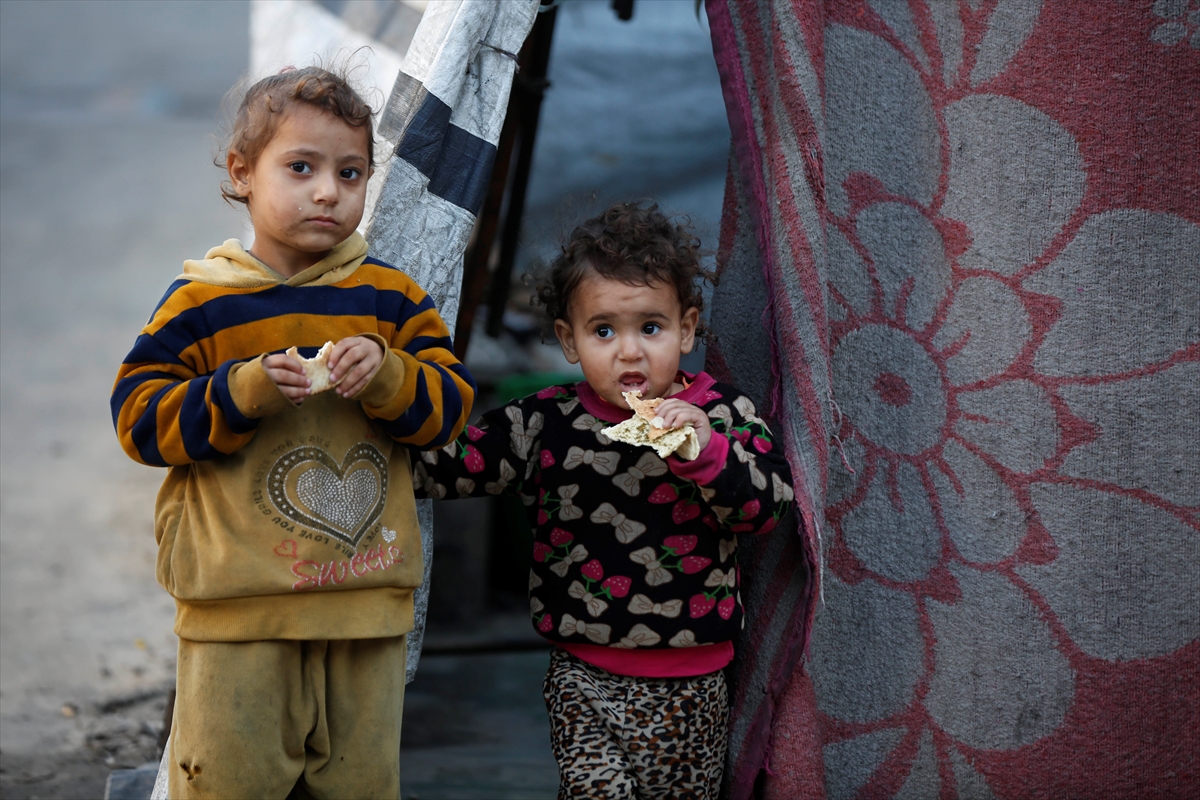
The health and education sectors have also suffered heavily. Twenty-two hospitals were disabled, 211 ambulances and 23 civil defence vehicles targeted, and 95% of schools damaged. Hundreds of educational and religious institutions were destroyed. Homes were demolished or rendered uninhabitable, displacing approximately 213,000 Palestinians, while shelters housing displaced persons were attacked. According to WAFA, the death toll since October 2023 has reached 71,269, with 171,232 injured. Severe weather has compounded the crisis, causing at least 19 additional deaths from building collapses in recent months.
[Photo: Children eat bread as the school belonging to the United Nations Relief and Works Agency for Palestine Refugees (UNRWA) is being used as a shelter by displaced Palestinian families in Deir al-Balah, Gaza on December 31, 2025. Displaced families, including women and children, are continuing to live inside the school building due to a lack of tents and alternative shelter options. Photojournalist: Stringer/AA]