By Ahmed J Versi
London, (The Muslim News): In a diverse society, debates about religion in public space are inevitable—and necessary. But when those debates are inconsistent, a more troubling conclusion suggests itself.
That question now hangs over criticism of a public iftar and prayer gathering in Trafalgar Square, which Shadow Justice Secretary Nick Timothy described as an “act of domination”. It is an unusually charged label of what appears to have been a peaceful act of worship —one that warrants scrutiny not only for its accuracy but for its selectivity.
A spokesperson for Leader of the Opposition, Kemi Badenoch framed the defence in the language of principle. Britain, they argued, is open and tolerant, but freedom of religion must be balanced against the risk of “exclusionary” use of shared civic spaces. Badenoch, supporting Timothy, added that he was “defending British values” . On its face, that is uncontroversial. Public space belongs to everyone, and no group should monopolise it to the exclusion of others. The difficulty lies in how—and to whom— that principle is applied.
Even the claim that the event was “exclusionary” rests on uncertain ground. When pressed, the spokesperson admitted it was unclear whether women had actually been excluded. The assertions appeared to rely on visual impressions: a particular section of the gathering seemed to consist only of men. He said there were, “No women inside the barrier at that event, and that is— well, when you start excluding women from shared civic spaces, you are undermining social cohesion.” That is not evidence of exclusion; it is an assumption. The absence of women in one area does not prove they were barred from participation. It may reflect choice, custom, or the practical organisation of the event. Indeed, footage appears to show men and women praying together, undermining the central premise of the criticism.
More revealing than the weakness of the evidence is the inconsistency of the outrage.
Religious and cultural events featuring prayer have taken place in public spaces across Britain for years — including those organised by Hindu, Jewish and Christian communities. Such events are not typically described as “acts of domination”, nor have they provoked the same level of political condemnation.
Even within the same exchange, this inconsistency emerges. A journalist pointed out that Orthodox Jewish groups hold male-only prayer gatherings in public spaces. Would these, undermine the same principle, also be deemed unacceptable? No clear answer was given.
That silence is telling. If “exclusionary” events truly undermine social cohesion, then it must apply universally — including where gender-separated participation is long established. Otherwise, the principle begins to look less like a neutral standard and more like a selectively applied one. It is in that gap — between stated principle and actual application — that the charge of bias arises.
To be clear, not every criticism of a Muslim gathering singles prejudice. But when a peaceful act of Muslim prayer is singled out as “domination”, when evidence for exclusion is uncertain, and when comparable practices by other groups attract no similar scrutiny, it is reasonable to ask whether something more than principle is at work.
At the very least, it suggests that Muslim expressions of faith in public space are being interpreted through a different lens — one quicker to infer threat, and slower to extend the benefit of the doubt. It is a lens of Islamophobia.
Language shapes perception. Describing a religious gathering as an “act of domination” is not merely criticism—it is a brazen challenge on the intentions and integrity of all who take part, risking, without evidence, the very division it claims to challenge. If the goal is genuinely to uphold shared values — openness, tolerance, cohesion — then those values must be applied consistently. They cannot depend on who is praying. Otherwise, the debate is no longer about the use of public space; It is about which communities are deemed to belong within it. That is a far more serious problem than the one it claims to address.
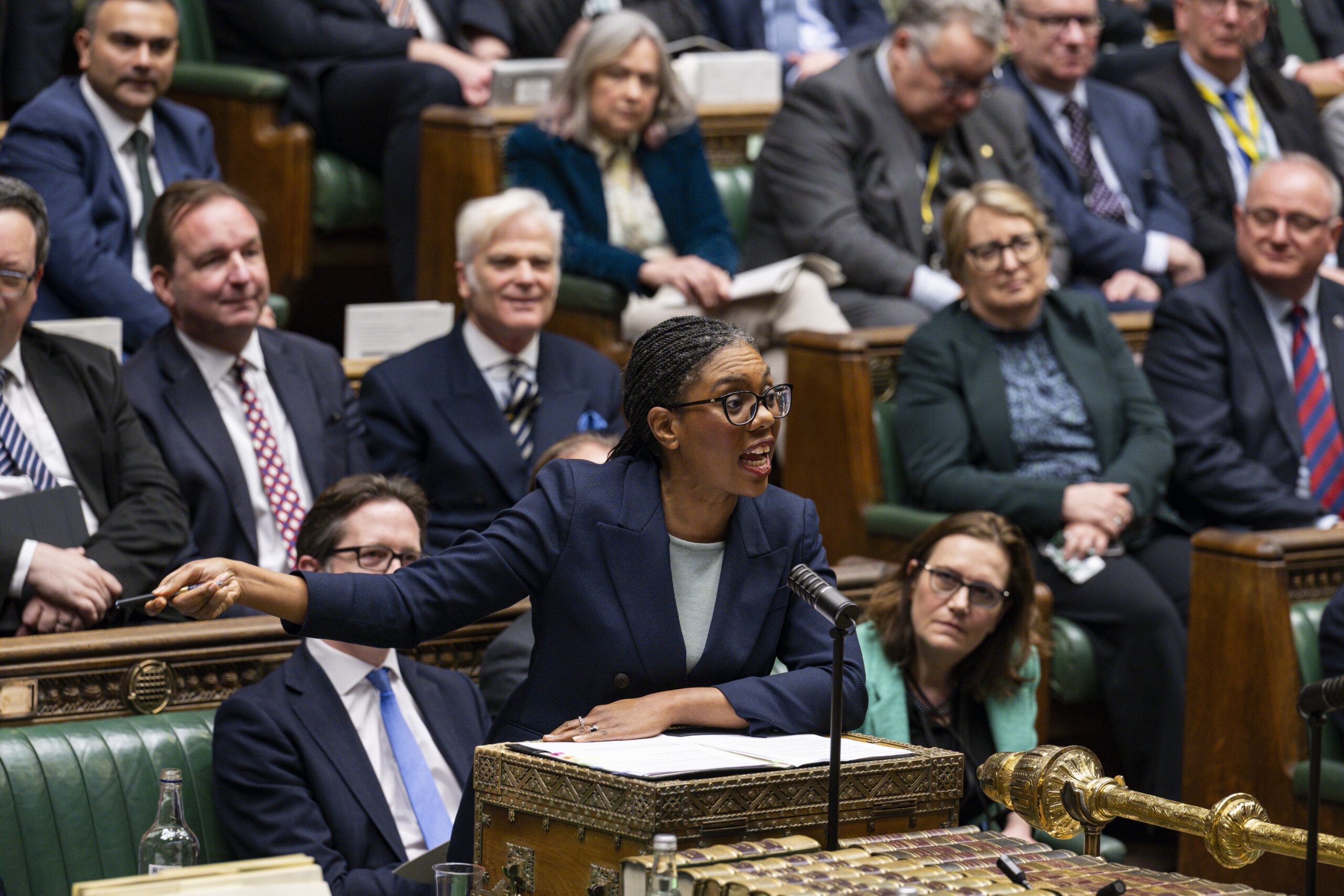
[Photo: Opposition Leader Kemi Badenoch supporting comments made by Shadow Justice Secretary on Muslim praying in Trafalgar Square at the PMQs on 18 March. Phoo Copyright House of Commons]