By Middle East Correspondent
LONDON, (The Muslim News): Israeli forces have been accused of killing and wounding Palestinians in a series of fresh attacks in Gaza, while demolitions, raids and settlement expansion continue across the occupied West Bank and Israeli strikes persist in southern Lebanon.
The death toll from Israel’s war on the Gaza Strip has risen to 73,388 Palestinians, with a further 174,259 wounded, according to Palestinian medical sources.
The figures cover the period since the conflict began in October 2023 and were released as a ceasefire in Gaza came under renewed strain following a series of reported Israeli attacks.
Medical sources said Gaza hospitals received the body of one Palestinian recovered from beneath the rubble during the previous 24 hours, while two wounded people were also brought in for treatment.
Since the ceasefire came into effect on October 11 last year, 1,259 Palestinians have reportedly been killed and 4,148 wounded, according to Palestinian Health Ministry figures. A further 808 bodies have been recovered.
The figures are expected to rise, with Palestinians still trapped beneath collapsed buildings and on roads across the devastated territory.
Ambulance crews and civil defence teams continue to face severe difficulties reaching victims because of destroyed roads, damaged infrastructure and the scale of destruction.
Four wounded in latest Gaza strikes
Four Palestinians were wounded on Wednesday in two separate Israeli attacks targeting civilians in northern and southern Gaza, according to Palestinian medical sources.
The incidents were reported as the first such attacks in more than a week and were described by Palestinian officials as another violation of the ceasefire.
At Al-Shifa Hospital, medical workers treated two people who had been wounded when an Israeli drone struck a three-wheeled vehicle, known as a tuk-tuk, near the western roundabout in Beit Lahia in northern Gaza.
One of the victims was said to be in critical condition.
Initial reports had said that one of the two people had been killed, but medical sources later clarified that he remained alive but was critically wounded.
In southern Gaza, an elderly man and a child suffered moderate injuries when an Israeli drone reportedly dropped a grenade on a gathering of civilians in central Khan Younis.
The wounded were taken to Nasser Hospital, according to medical sources.
Elsewhere in central Gaza, Israeli military vehicles and drones reportedly opened heavy fire towards homes east of the Bureij refugee camp.
The latest incidents came days after Palestinian sources reported a decline in Israeli airstrikes and targeted killings, although they said ceasefire violations had continued.
The attacks have also raised questions over the future of a broader political plan for Gaza.
Israeli media have reported that Israel was implementing on the ground a 15-point plan approved by the Board of Peace and accepted by Hamas. Israeli Prime Minister Benjamin Netanyahu, however, rejected the plan on Sunday, according to the reports.
Gaza left devastated
The latest Palestinian casualty figures bring the reported death toll from the war to more than 73,000, with more than 174,000 wounded.
Palestinian authorities say the overwhelming majority of those killed and injured have been civilians, including large numbers of women and children.
The offensive has also left vast areas of Gaza in ruins.
Around 90 per cent of civilian infrastructure has reportedly been damaged, while the United Nations has estimated the cost of reconstruction at about $70 billion.
Entire neighbourhoods have been flattened, leaving hundreds of thousands of people without homes and placing enormous pressure on an already devastated health system.
The continued discovery of bodies beneath destroyed buildings means the full death toll may remain unknown for years.
Israeli raids and demolitions sweep West Bank
While the ceasefire remains under pressure in Gaza, Israeli military operations and demolitions have continued across the occupied West Bank.
Israeli forces raided Balata refugee camp, east of Nablus, on Wednesday, with military patrols entering the camp and surrounding neighbourhoods.
Infantry units were deployed along Al-Madaris Street, while troops also raided several Palestinian homes.
There were no immediate reports of arrests or clashes.
Further south, Israeli forces demolished a three-storey Palestinian residential building in Al-Ma’sara, south of Bethlehem.
Three Palestinian families were displaced by the demolition.
The operation took place in Area C, which accounts for roughly 60 per cent of the occupied West Bank and remains under full Israeli control under the Oslo II arrangements.
Palestinian authorities said Israel carried out 341 demolitions during the first half of 2026, destroying 740 structures, affecting 923 Palestinians and issuing 254 demolition or stop-work orders.
70-year-old Hebron home bulldozed
Another Palestinian home was demolished in Hebron on Wednesday, according to WAFA.
Palestinian resident Hakam al-Zarou said Israeli forces used bulldozers to destroy his two-storey home in the Farsh al-Hawa area.
The approximately 300-square-metre property had stood for more than 70 years.
Al-Zarou said he was taken by surprise by the demolition and that he had received no prior warning or explanation.
The demolition brought to three the number of Palestinian homes reportedly destroyed by Israeli bulldozers since the morning.
Other demolitions were reported in Silwan in occupied East Jerusalem and Al-Ma’sara south of Bethlehem.
Israeli analyst warns of West Bank ‘loss of control’
The escalation prompted a stark warning from Israeli military analyst Amos Harel, writing in Haaretz. Harel said Israeli forces and police had, in his assessment, “completely lost control of the West Bank in recent months”, amid growing violence by Israeli settlers.
He said settlers were establishing farms and outposts and systematically forcing Palestinian communities from their land, while Israeli soldiers and police frequently failed to intervene.
Harel described the situation as involving a political wing comprising ministers and regional council leaders and a violent force operating on the ground.
He said the ultimate objective was to drive Palestinians from their land and seize additional territory.
Israeli forces have conducted near-daily raids, arrests and searches across West Bank cities, towns and refugee camps during the war in Gaza.
Palestinians have also reported killings, home demolitions, mosque arson, land levelling, forced displacement and accelerated settlement construction.
Palestinian officials have repeatedly warned that the campaign is creating conditions for the eventual formal annexation of the West Bank and threatening the possibility of an independent Palestinian state.
Smotrich boasts of demolitions near Jenin
The campaign has also received open political backing from Israel’s far-right Finance Minister Bezalel Smotrich.
Smotrich, leader of the Religious Zionism party, said on X on Wednesday that Israel had begun demolishing 26 Palestinian buildings near Jenin in the northern West Bank.
He described the buildings as “illegal” and published photographs purporting to show the demolition operation.
The demolitions come amid accelerating illegal Israeli settlement activity in the occupied territory.
Israel evacuated the settlements of Ganim and Kadim, along with Homesh and Sa-Nur, in 2005 under its disengagement plan.
But restrictions on Israeli access to parts of the northern West Bank have subsequently been rolled back.
In March 2023, Israel’s parliament amended the disengagement legislation to remove restrictions preventing Israelis from entering and living in areas evacuated in 2005.
In late 2025, the Israeli government approved the re-establishment of Ganim and Kadim as part of plans involving 19 settlements in the occupied West Bank.
Thousands of new settlement homes approved
The illegal settlement drive has continued at pace. According to the latest UN secretary-general’s report on Israeli settlements, Israeli authorities advanced or approved plans for 4,750 settlement units in the occupied West Bank, including occupied East Jerusalem, between March 14 and June 12.
On March 25, the Israeli government also approved the establishment or legalisation of 34 settlements in Area C, reportedly the largest number approved in a single Israeli government decision.
The United Nations has repeatedly condemned Israeli settlements in territory occupied since 1967.
UN Security Council Resolution 2334 states that Israeli settlements in the occupied Palestinian territory, including East Jerusalem, have “no legal validity” under international law.
Nearly 4,800 Palestinian young people in Israeli prisons
Meanwhile, Palestinian officials said 4,769 young Palestinians were being held in Israeli prisons.
The figure was released by Raed Abu al-Hummus, head of the Palestinian Commission of Detainees’ Affairs, on International Youth Day.
He said 4,713 male prisoners aged between 18 and 40 were being held alongside 56 young women.
Abu al-Hummus also said 41 of the 91 Palestinian prisoners who had died in Israeli custody since October 2023 were young people.
The bodies of 40 of those prisoners remain in Israeli custody, he said.
More than 9,400 Palestinians are reportedly held in Israeli jails, including 92 women and more than 370 children, according to Palestinian and Israeli rights organisations.
Palestinian rights groups have accused Israel of subjecting detainees to torture, starvation and medical neglect, allegations Israel has rejected.
Abu al-Hummus said Palestinian young people had the same right to life, freedom, work and movement as young people elsewhere.
He called on international organisations to oppose what he described as the targeting of Palestinian youth and to press for an end to restrictions imposed by the Israeli occupation.
Wider regional tensions remain.
Israel blows up school in southern Lebanon
The violence has not been confined to Gaza and the West Bank.
Israeli forces reportedly blew up civilian buildings in southern Lebanon on Wednesday, including a school, while an Israeli drone also struck a site used to commemorate Ashura [tenth day of Muharram, first month in Islamic Calender] martyrdom of grandson of Prophet Muhammad.
Lebanon’s National News Agency reported that Israeli forces detonated and destroyed the four-storey Sheikh Naim Mahdi School in the centre of Eastern Zawtar.
Explosions were also reported in the Touline Valley along the Wadi al-Saluki road.
Two large explosions were reported overnight in Haddatha, followed by another major blast in Beit Yahoun in the Bint Jbeil district.
An Israeli drone reportedly struck an Ashura commemoration site on the Kafra-Al-Asi road, causing several injuries.
Another Israeli drone was reported flying over Beirut’s southern suburbs.
Lebanese authorities say Israel’s offensive against Lebanon has killed 4,335 people, wounded 12,277 and displaced more than one million. The figures come despite ongoing negotiations intended to reduce tensions between the two sides.
Under US sponsorship, Beirut and Tel Aviv signed a framework agreement on June 26 calling for the gradual withdrawal of Israeli forces from occupied Lebanese territory in return for the deployment of the Lebanese army and the disarmament of armed groups, including Hezbollah.
Israel nevertheless continues to hold territory in southern Lebanon, with some areas occupied for decades and others taken during the 2023-24 conflict.
Lebanese PM condemns destruction
Lebanese Prime Minister Nawaf Salam rejected Israel’s claim that destroyed villages in southern Lebanon contained military sites. “The justification for these bulldozing and destruction operations under the pretext of the presence of military installations is refuted by the very nature of what is being targeted,” Salam said.
He argued that describing entire villages, towns, homes, government buildings, public facilities, places of worship and infrastructure as military installations was illogical and could not justify their destruction.
Salam said the attacks constituted a serious violation of international humanitarian law and insisted that Lebanon’s sovereignty and the right of southern residents to return and rebuild were “non-negotiable”.
The Lebanese army separately said continued Israeli attacks were preventing it from completing its deployment in the south and were obstructing the return of displaced residents.
The army said Israeli forces had destroyed civilian facilities and homes in Eastern Zawtar.
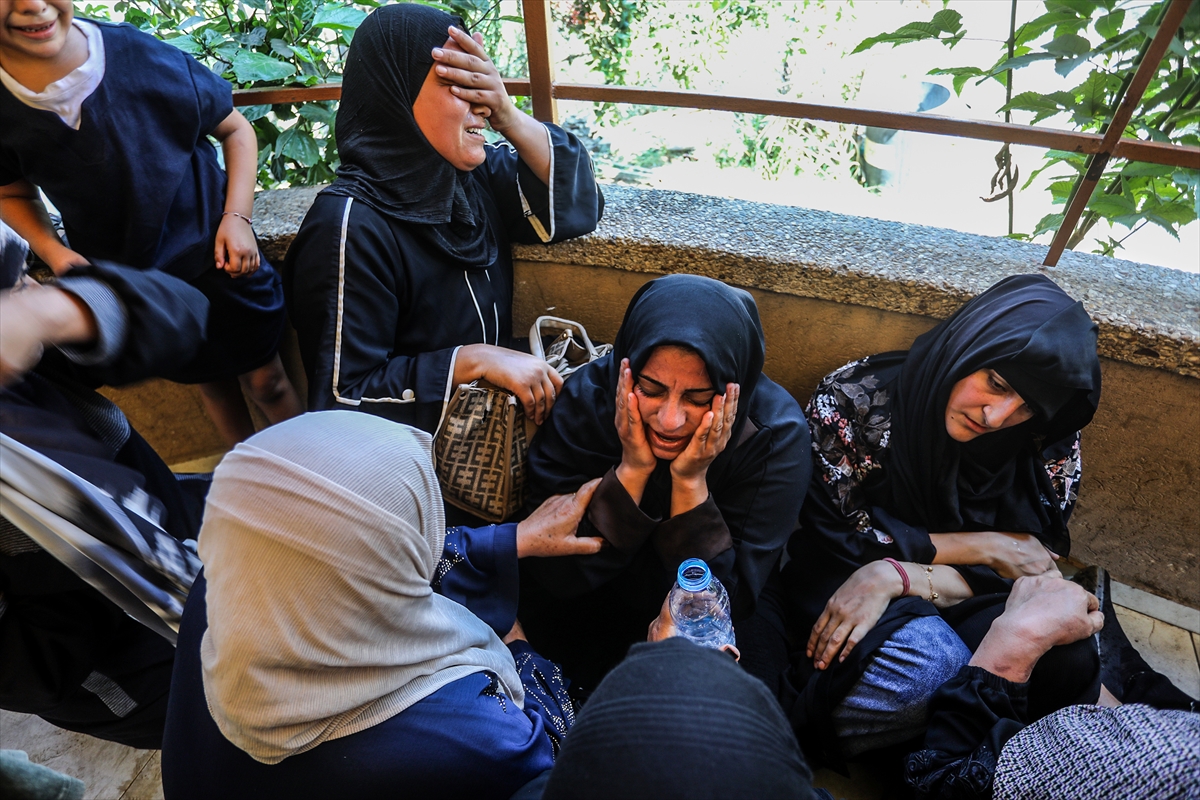
[Photo: Relatives of the Palestinian killed in Israeli attack on Al-Amal neighborhood, mourn during a funeral ceremony held at Nasser Hospital in Khan Yunis, Gaza on August 13, 2026.
Photojournalist: Abed Rahim Khatib/AA]