By Ashfaq Ahmed
London, (The Muslim News): After a two-year absence, returning to the World of Music, Arts and Dance (WOMAD) Festival felt like stepping into a world without borders. This year, the festival opened a new chapter at its idyllic home, Neston Park in Wiltshire, where music, languages, and traditions from across the globe converged over one remarkable weekend.
Wandering through the festival grounds toward the World Stage, I passed ripening walnuts hanging heavily from branches overhead, their green husks mimicking raw mangoes. Nearby, mature horse chestnuts cast shade over families resting on straw bales. Beyond the music, dance, talks, and bustling market stalls lay vast fields of sunflowers, their golden faces stretching toward the horizon. Everywhere, there was a quiet sense of discovery—as though the world had been gathered into a single landscape.
That is the enduring magic of WOMAD. It allows visitors to travel continents without leaving Britain, immersing themselves in the music, food, art, and conversations of cultures they might otherwise never encounter.
This year’s gathering welcomed around 460 performers from 38 countries. Between concerts, festival-goers explored workshops, sampled international cuisine, and browsed artisan stalls, while the World of Words hosted thought-provoking discussions featuring speakers such as Zack Polanski and Baroness Shami Chakrabarti.
Yet among such an extraordinary lineup, it was a softly spoken musician from Pakistan’s remote Balochistan province who left the deepest impression.
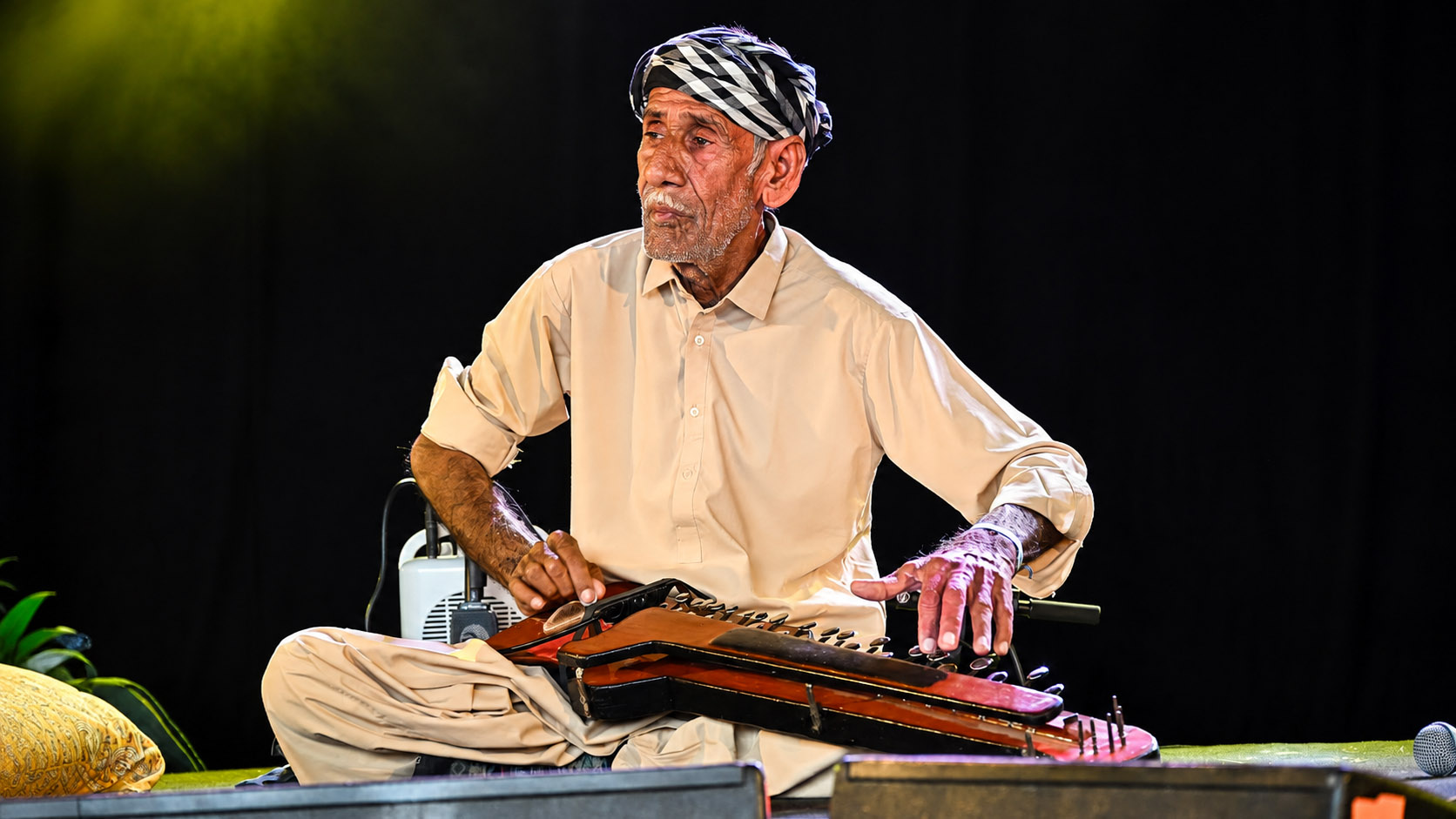
Far from the festival’s main stages, Ustad Noor Bakhsh transformed the intimate Village Stage into one of its most captivating sanctuaries. There were no elaborate visual effects or theatrical flourishes—only a man, his instrument, and an audience gradually falling under his spell.
So compelling was his performance that members of India’s Wild Wild Women and the Ta Dhom Project—having just finished their own acclaimed sets nearby—quietly slipped into the front row to listen. When accomplished artists choose to spend their rare downtime listening to another, it speaks louder than any review.
Few watching would have guessed that this soft-spoken elder, dressed in a black Balochi turban and traditional shalwar kameez, had once roamed the rugged Makran landscape as a young nomadic shepherd. Rather than telling his story with words, he let his electric benju speak for him.
As a boy, Noor Bakhsh would abandon his flock whenever he heard the distinctive chime of the benju played by the celebrated Ustad Khuda Bakhsh. Fascination soon grew into devotion, and at twelve, he was accepted as a disciple in the traditional apprenticeship ceremony of “tying the thread”—a rite marking the start of a lifelong musical quest.
The benju itself has travelled a remarkable path. Derived from the Japanese taishōgoto, the instrument was embraced and transformed by Balochi musicians into something entirely their own. Over decades, Noor Bakhsh expanded its vocabulary further, weaving Balochi folk with Persian, Kurdish, and Sindhi traditions, South Asian ragas, Arabic melodies, and even popular Bollywood tunes.
Nature, too, remains a vital muse. Many of his compositions echo the birdsong surrounding his village of Pasni on Pakistan’s Makran coast. His acclaimed debut album, Jingul, takes its name from a small bird that once nested inside his family home.
At seventy-eight, his fingers still danced across the keys with astonishing speed and precision. One moment delicate and meditative, the music would suddenly surge with dazzling complexity. The instrument no longer seemed separate from him, but an extension of his spirit, its melodies floating beyond language, nationality, and faith. The audience needed no translation; they simply listened.
During a brief pause, I asked Daniyal—his manager and an accomplished flutist and damboora player—whether Noor Bakhsh might play a favourite melody of mine, made famous by the legendary Sufi singer Abida Parveen: Jab Se Tune Mujhe Deewana Bana Rakha Hai. Daniyal smiled and promised to ask.
Noor Bakhsh saved it for the grand finale.
As those haunting opening notes drifted across the Village Stage, conversation vanished. The melody floated gently beneath the canopy of trees, and for a few precious minutes, time itself stood still.
Afterward, I queued at the WOMAD shop to buy a vinyl copy of Jingul. Handing over the sleeve for an autograph, Daniyal gently explained that Noor Bakhsh could not write his name.
Instead, the master took a black marker, carefully inked his thumb, and pressed a clean, dark print onto the sleeve.
It was a simple gesture, yet profoundly moving. It brought back memories of my late father, who authenticated official documents the exact same way because he had never been taught to write. Moments earlier, those hands had flown across the benju with breathtaking virtuosity. They could not write a signature, yet they had communicated more eloquently than words ever could. His thumbprint was not just a mark—it was the seal of a life written entirely in melody.
Leaving Neston Park, I realized the greatest journey of the weekend had not been across map lines, but into the life of one remarkable artist. A humble shepherd from a remote Balochi village had become one of Pakistan’s finest cultural ambassadors.
In a world too often defined by conflict and division, Ustad Noor Bakhsh offered a quieter, more enduring truth: music remains humanity’s universal language. Beneath the trees at WOMAD, his melodies accomplished what politics so rarely can—they brought strangers together in shared wonder.
Ashfaq Ahmed is a teacher
[Photo: Ustad Noor Bakhsh performing at WOMAD. Photographer: Ashfaq Ahmed/The Muslim News]