By Middle East Correspondent
London, (The Muslim News): The Foreign Press Association (FPA) on Tuesday expressed “profound disappointment” at the Israeli government’s continued refusal to grant unrestricted access to international journalists seeking to report from the Gaza Strip, despite a ceasefire now being in place.
In a statement, the association, which represents US-based foreign correspondents, criticised Israeli authorities for failing to outline any plan that would allow journalists to enter Gaza independently and work alongside Palestinian reporters on the ground. “Instead of presenting a plan for allowing journalists into Gaza independently and letting us work alongside our brave Palestinian colleagues, the government has decided once again to lock us out,” the statement said, adding that the decision had been taken even as hostilities had formally paused.
Israel has severely restricted independent access for international media since the war on Gaza began in 2023, permitting only a limited number of reporters to enter the territory under military escort and on a case-by-case basis.
According to Israeli media reports, the government told the Supreme Court on Sunday that the ban should remain in force, citing what it described as ongoing “security risks”. The FPA said it intends to submit a “robust response” to the court in the coming days.
“The FPA is confident that the court will provide justice in light of the continuous infringement of the fundamental principles of freedom of speech, the public’s right to know and free press,” the association said.
Concerns over press freedom have been compounded by the scale of journalist casualties during the conflict. In early December 2025, Gaza’s government media office said that 257 Palestinian journalists had been killed during the Israeli offensive on Gaza, which began on October 8, 2023, and continued for two years until a ceasefire agreement took effect in October 2025.
Israel killed more journalists in 2025 than any other country, according to a report published on Tuesday by Reporters Without Borders (RSF). The organisation said Israeli forces were responsible for the deaths of 29 Palestinian reporters during the war, marking the third consecutive year in which Israel was named the world’s leading killer of journalists.
Overall, 67 journalists were killed globally in 2025, one more than the previous year. “This is where the hatred of journalists leads,” said Thibaut Bruttin, RSF’s director general. “It led to the death of 67 journalists this year – not by accident, and they weren’t collateral victims. They were killed, targeted for their work.”
Bruttin also criticised what he described as the failure of international organisations to adequately protect journalists in conflict zones, attributing the rising death toll to a broader decline in the “courage of governments”. “Journalists do not just die – they are killed,” he said.
Israeli army kills two people in Lebanon despite ceasefire
Meanwhile, Israeli airstrikes killed two people and injured a third in southern Lebanon on Tuesday, in what Lebanese authorities described as further violations of a ceasefire agreement. Lebanon’s Health Ministry said the fatalities occurred when an Israeli drone struck the town of Kafrdounin in the Bint Jbeil District.
The state-run National News Agency (NNA) reported that an Israeli aircraft also fired two missiles at a three-storey building in the town of Ghaziyeh, near Sidon. One person was injured in that attack, according to the Health Ministry.
The strikes came amid Israeli media reports of preparations for a possible large-scale assault on Hezbollah positions should the Lebanese government and army fail to dismantle the group’s weapons.
Lebanon and Israel have observed a ceasefire since November 2024, ending more than a year of cross-border hostilities linked to the war on Gaza. More than 4,000 people were killed and 17,000 injured during that period.
Under the terms of the agreement, Israeli forces were due to withdraw fully from southern Lebanon in January. However, while some troops pulled back, the Israeli army continues to maintain a presence at five border outposts.
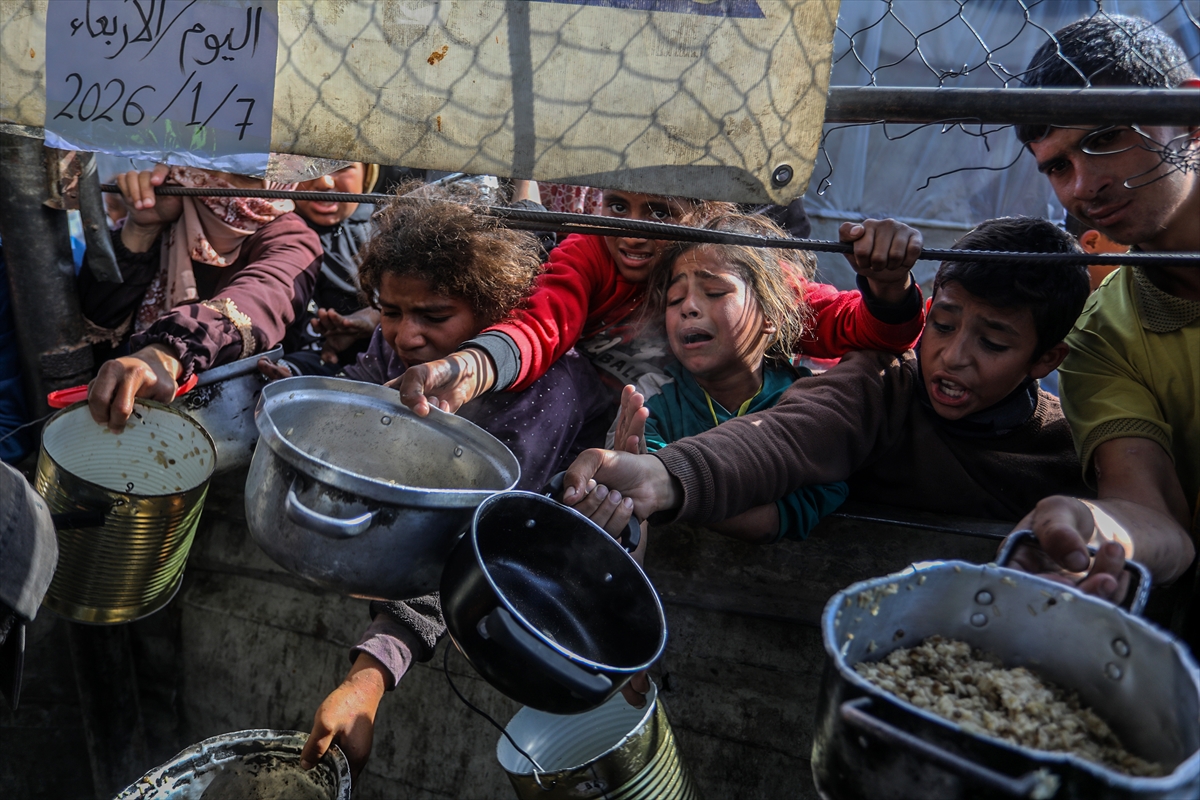
[Photo: Palestinians, mainly children, wait to get hot food distributed by a charity organization at al-Mawasi district of Khan Yunis, Gaza on January 7, 2026. Photojournalist: Abed Rahim Khatib/AA]