By Elham Asaad Buaras
LONDON, (The Muslim News): Five Palestinians were killed and 14 others, including two children and a displaced woman, wounded in Israeli attacks across the Gaza Strip on Tuesday, while armed Israeli settlers attacked Palestinian farmers in the occupied West Bank, amid continuing violations of the ceasefire agreement. Meanwhile, Tehran denies negotiations with Washington amid escalating tensions over the Strait of Hormuz and French cyberattack allegations
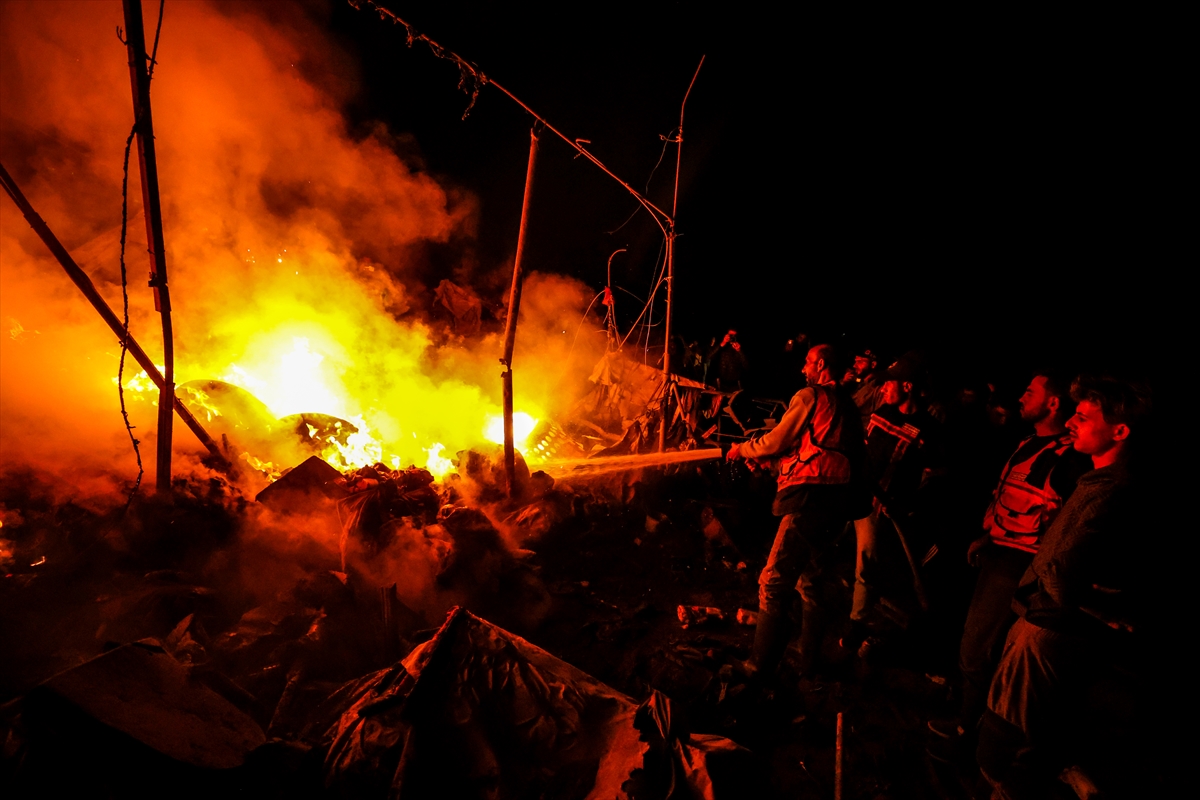
In the latest attack, an Israeli drone struck a workshop under construction in the Tel al-Hawa neighbourhood of southern Gaza City, killing one Palestinian and injuring eight others.
A separate drone strike hit a tent sheltering displaced Palestinians at a refuge in eastern Gaza City, killing one person and injuring others.
In the Zeitoun neighbourhood southeast of Gaza City, a 43-year-old Palestinian man and his 13-year-old son were killed when an Israeli strike hit the roof of a building sheltering displaced families. The man’s wife and another Palestinian were injured.
Local sources said the drone struck the roof of the Ministry of Endowments building in the Asqoula area of Zeitoun, which was being used to shelter displaced civilians.
In southern Gaza, a 26-year-old man was killed by Israeli forces in Khan Younis.
A displaced woman sustained moderate injuries from Israeli gunfire in the Bir 19 area southwest of the city, while a five-year-old child was wounded by gunfire inside Mustafa Hafez School, which is sheltering displaced Palestinians in central Khan Younis.
An Israeli naval attack also wounded a fisherman after gunboats opened fire on fishing vessels off the Khan Younis coast. Local sources said the boats were targeted with gunfire and shells near the city’s port, setting two vessels ablaze.
Another boy was wounded when Israeli military vehicles opened fire towards tents sheltering displaced people in the Batn al-Samin area south of Khan Younis.
Witnesses reported intense Israeli artillery shelling south and east of the city, accompanied by heavy gunfire from military vehicles.
In central Gaza, Israeli military vehicles made a limited incursion southeast of the Maghazi refugee camp, amid heavy gunfire and artillery shelling.
The Israeli army also blew up evacuated homes and civilian structures near the area.
According to Gaza’s Health Ministry, Israeli attacks have killed 1,615 Palestinians and wounded 5,849 since the ceasefire took effect on October 10, 2025.
Since October 2023, Israel’s war on Gaza has killed more than 74,000 Palestinians and wounded over 175,000, most of them women and children, while destroying around 90 per cent of the enclave’s infrastructure.
Israeli settlers attack Palestinian olive harvesters under protection of Israeli forces
Meanwhile, armed Israeli settlers attacked Palestinian olive harvesters in the village of Bireen, east of Hebron, on Tuesday evening, injuring several farmers and stealing their harvest.
Anti-settlement activist Ratib al-Jabour told WAFA news agency that settlers, accompanied by Israeli occupation forces, attacked farmers picking olives in the Khillet al-Furn area, leaving several with bruises and contusions.
The settlers stole the harvested olives, while Israeli soldiers seized a tractor and detained one farmer.
In a separate incident, settlers forced a Palestinian family out of its olive groves in Wadi Ma’in in Masafer Yatta, stealing its olive crop and agricultural equipment.
In Beit al-Roush, west of Hebron, several Palestinians suffered suffocation from tear gas and two farmers were detained during an attack by settlers and Israeli forces.
WAFA reported that armed settlers assaulted farmers with pepper spray and prevented them from ploughing their land. Israeli forces subsequently raided the area and fired tear gas canisters, causing several Palestinians to suffer suffocation.
Two farmers from the Hreibat family were detained.
Settler violence across the occupied West Bank includes attacks on Palestinian homes and property, arson targeting buildings and mosques, stone-throwing, and the destruction of crops and olive trees.
Approximately one million Israeli settlers live in settlements across the West Bank and East Jerusalem, which are considered illegal under international law.
Iran denies negotiations with US
Separately, Iran’s top security official denied that Tehran was negotiating with Washington or planning a meeting in Qatar, dismissing US claims of ongoing diplomatic contacts.
Supreme National Security Council Secretary Mohsen Rezaei described reports of continuing negotiations or a planned meeting in Qatar as “complete lies”, according to the semi-official Tasnim news agency.
Speaking in a television interview, Rezaei accused Washington of spreading the claims to ease economic pressure on Iran and drive down oil prices.
“I emphasise that we are not currently conducting any negotiations with the Americans, and there are no negotiations between us and Washington at present,” he said.
Rezaei said Tehran had presented seven conditions which it considered the legitimate rights of the Iranian people, adding that the Strait of Hormuz would remain closed until all seven were implemented.
“We have communicated our conditions to the American side, but their initial response was insufficient and deceptive, and we are still awaiting an explicit and clear response,” he said.
He also denied reports of a planned meeting with US Vice President JD Vance, describing them as baseless.
Iranian Foreign Minister Abbas Araghchi had earlier rejected reports of a meeting between Rezaei and Vance, saying Tehran’s two-day proposal remained on the table.
The denials followed remarks by US Secretary of State Marco Rubio, who said on Monday that a diplomatic agreement with Iran might not be possible, describing Tehran’s demands as “outrageous and ridiculous”.
Speaking before departing for a G7 foreign ministers’ meeting in Paris, Rubio said several countries were continuing to engage Iran with proposals, but Washington was not close to a breakthrough.
He said US President Donald Trump preferred a diplomatic solution while acknowledging that an agreement might not be achievable.
After the G7 meeting on Tuesday, Rubio said Washington saw no need to resume major combat operations against Iran, arguing that economic pressure was achieving its objectives. He said the US would continue its economic campaign against Tehran but warned that American forces remained ready to respond if Iran crossed Washington’s “red lines”.
Qatar said it had received positive responses from Washington and Tehran regarding its ongoing mediation efforts, although it acknowledged uncertainty over the prospects of an agreement.
The diplomatic standoff comes amid continuing tensions over the Strait of Hormuz, where Iran’s Islamic Revolutionary Guard Corps (IRGC) Navy said a third oil tanker had exploded after striking a naval mine while attempting to use what it described as an “unauthorised” shipping route.
In a statement carried by Iranian state broadcaster IRIB, the IRGC Navy said the tanker struck the mine on Tuesday afternoon in the eastern part of the strategic waterway and caught fire.
The statement said smoke from the explosion and subsequent fire had spread across the skies above the strait. It did not identify the vessel, its flag or the number of crew members on board, and provided no information about casualties or environmental damage.
The IRGC Navy claimed that the destruction of US coastal radar and navigational aid systems south of the strait had increased the risks for vessels attempting to use unauthorised shipping routes, adding that ships navigating dangerous passages were striking naval mines.
Iranian authorities have repeatedly warned commercial vessels against using routes outside those designated by Tehran.
The maritime tensions follow the US-Israeli illegal military offensive against Iran launched on February 28. A ceasefire followed in April, and Washington and Tehran signed a memorandum in June aimed at reaching a peace agreement, but negotiations have yet to produce a final settlement.
In a separate diplomatic dispute, Iran rejected French accusations that it was responsible for cyberattacks targeting retail businesses in France, describing the allegations as baseless.
The Iranian Foreign Ministry denied any involvement and criticised what it called France’s accusatory approach towards Tehran, saying Iran would take measures it considered necessary to protect its national interests and security against “unlawful” foreign actions.
The response followed France’s accusations Monday that Iran had carried out cyberattacks targeting refrigeration controllers at more than 700 retail sites during the night of October 11-12.
The French Foreign Ministry said the attacks caused extensive material damage, fires and food losses estimated at tens of millions of euros. It attributed the operation to Shahid Kaveh, a cyber unit affiliated with Iran’s Islamic Revolutionary Guard Corps.
Paris said it would summon Iran’s ambassador and seek new European Union sanctions against Iranian individuals and entities allegedly involved in the attacks, while reserving the right to take further measures.
[Photo: Thick smoke and flames rise from the site as fires break out in tents sheltering displaced Palestinians in the Tel al-Hawa neighborhood following an Israeli army strike targeting a metalworking workshop south of Gaza City, Gaza, Palestine, on November 10, 2026. Photojournalist: Ali Jadallah/AA]