By Home Affairs Correspondent
Foreign Secretary Ed Miliband has announced a ban on British trade with illegal Israeli settlements in the occupied West Bank, triggering a furious backlash from Israel and the United States.
The sweeping measures will target goods produced in settlements and British companies providing construction, infrastructure, financial and property services linked to their expansion, as more than 700,000 Israeli settlers live across more than 160 illegal settlements. Israel has condemned the move, while US Ambassador to Israel Mike Huckabee accused Britain of “Jew hate”, escalating an already bitter dispute between London and its closest allies.
Miliband announced the measures in the House of Commons on September 8, insisting Britain could no longer stand by as settlement expansion threatens the creation of a Palestinian state.
The Government says the measures are designed to protect the prospect of a two-state solution and respond to Israel’s continued expansion into occupied Palestinian territory.
But the decision has immediately plunged Britain into a fresh diplomatic row with Israel and Washington.
Israeli President Isaac Herzog urged Britain to abandon sanctions in favour of dialogue, warning that the measures could prove a “grave miscalculation”.
Israeli officials have accused the British Government of singling out Israel, while ministers in Israel have continued to defend the country’s settlement drive.
The US response has been even more direct.
Huckabee accused the British Government of “Jew hate”, while Florida Republican Congressman Randy Fine threatened economic retaliation against British companies operating in Florida over measures he characterised as a boycott of Israel.
The confrontation comes as Israel pushes ahead with plans for 1,200 new illegal homes in the strategically sensitive E1 area east of Jerusalem.
The development would connect Jerusalem with the settlement of Ma’ale Adumim and effectively cut the West Bank in two, making it considerably harder to establish a contiguous Palestinian state.
Miliband has branded the E1 project an “unacceptable and destructive act”.
Israeli ministers, however, have made clear their determination to continue expanding settlements, with some openly arguing that the drive is intended to “bury the idea of a Palestinian state”.
More than 700,000 Israelis now live in settlements across the West Bank and East Jerusalem, according to Peace Now.
The settlements have expanded dramatically since Israel captured the West Bank in the 1967 war, despite widespread international opposition.
The expansion has also coincided with mounting violence and displacement of Palestinians.
More than 100 Palestinian communities have been partially or completely displaced by settler attacks since 2023, while more than 1,330 settler-related incidents have been recorded in 2026 alone.
UN figures cited in the background material show that more than 2,300 Palestinians have been displaced by settler attacks and access restrictions since the beginning of 2026, with more than 1,040 injured.
In August alone, 40 demolition and bulldozing operations targeted residential and commercial structures in Jerusalem.
Dr Julie Norman, an Associate Fellow at Chatham House who visited the West Bank this summer, described witnessing Palestinian villages being destroyed, including a school in Hamamat al-Maleh that was reduced to rubble.
She said settlement expansion was one of the biggest obstacles to creating a viable and contiguous Palestinian state, while the lack of prosecutions for settler attacks had helped drive Palestinians from rural communities.
The British move follows the International Court of Justice’s 2024 advisory opinion declaring Israel’s continued presence in the occupied Palestinian territories unlawful.
The court also said states must take steps to prevent trade or investment relations that help maintain the illegal settlement enterprise.
Amnesty International UK welcomed the Government’s announcement, describing an end to trade benefiting settlements as “long overdue”.
But it warned that a limited ban on settlement goods would not go far enough and called for effective enforcement and wider action.
UN Special Rapporteur Francesca Albanese also welcomed the move but warned that settlement goods represented only a small part of the economic activity sustaining the occupation.
She called on governments to implement the ICJ opinion more fully rather than allowing the announcement to become a symbolic gesture.
Britain has been under growing pressure to act.
Spain, Ireland, Belgium and the Netherlands have introduced similar measures, while France has called for the European Union to end imports from Israeli settlements.
More than 140 Labour MPs have also called for action against Israeli companies operating in the occupied West Bank.
Polling cited in the background material suggests British voters support banning trade with illegal settlements by more than two to one.
The Government has insisted that its measures are directed at settlements and do not amount to a boycott of Israel itself.
Under the existing UK-Israel Free Trade Agreement, Britain and Israel already distinguish between goods produced inside Israel and those originating from settlements in occupied territory.
But the policy has provoked anger among some Jewish communal leaders in Britain.
Chief Rabbi Sir Ephraim Mirvis, who met Miliband to convey what he called the community’s “deep dismay”, warned that the measures could prove counterproductive and potentially develop into a wider boycott of Israel.
He also raised concerns about their impact on British Jews with close connections to Israel.
Dr Norman rejected the suggestion that targeting settlement activity was antisemitic or anti-Israel, arguing that the measures were aimed specifically at settlements and did not challenge Israel’s existence within its pre-1967 borders.
Prime Minister Andy Burnham also met Jewish communal leaders at Downing Street on September 3 as tensions over the proposed measures intensified.
Following the meeting, the Government announced an emergency Cabinet Committee on Antisemitism to coordinate security measures for the Jewish community during the High Holy Days.
Meanwhile, Shadow Foreign Secretary Tom Tugendhat warned that sanctions could damage Britain’s national security by affecting intelligence cooperation with Israel.
Supporters of the Government’s policy rejected that argument, saying opposition to settlement expansion should not be conflated with Britain’s wider security relationship with Israel.
There are also questions over whether the new measures will have a meaningful economic impact.
Bloomberg has reported that British diplomats privately regard the sanctions as largely symbolic and that traders could potentially circumvent restrictions by relabelling goods.
Supporters, however, argue that the measures carry significant political and legal weight, particularly following the ICJ ruling.
The Muslim Council of Britain welcomed the announcement but said action against settlement trade was “long overdue”.
Dr Wajid Akhter, MCB Secretary General, said Britain should go further to ensure those responsible for crimes against Palestinians are held accountable and Palestinians are able to exercise their right to statehood.
The Government now faces an increasingly difficult balancing act.
While Britain insists it is acting to defend international law and the possibility of a two-state solution, Israel and Washington accuse it of taking sides in the conflict.
And with settlement construction accelerating and the E1 project threatening to carve the West Bank in two, the stakes are rising over whether Miliband’s new measures will actually halt Israel’s expansion — or simply provoke another diplomatic showdown with two of Britain’s most important allies.
The Muslim News response to the statement of Foreign Secretary Ed Miliband will appear in this month’s issue of The Muslim News
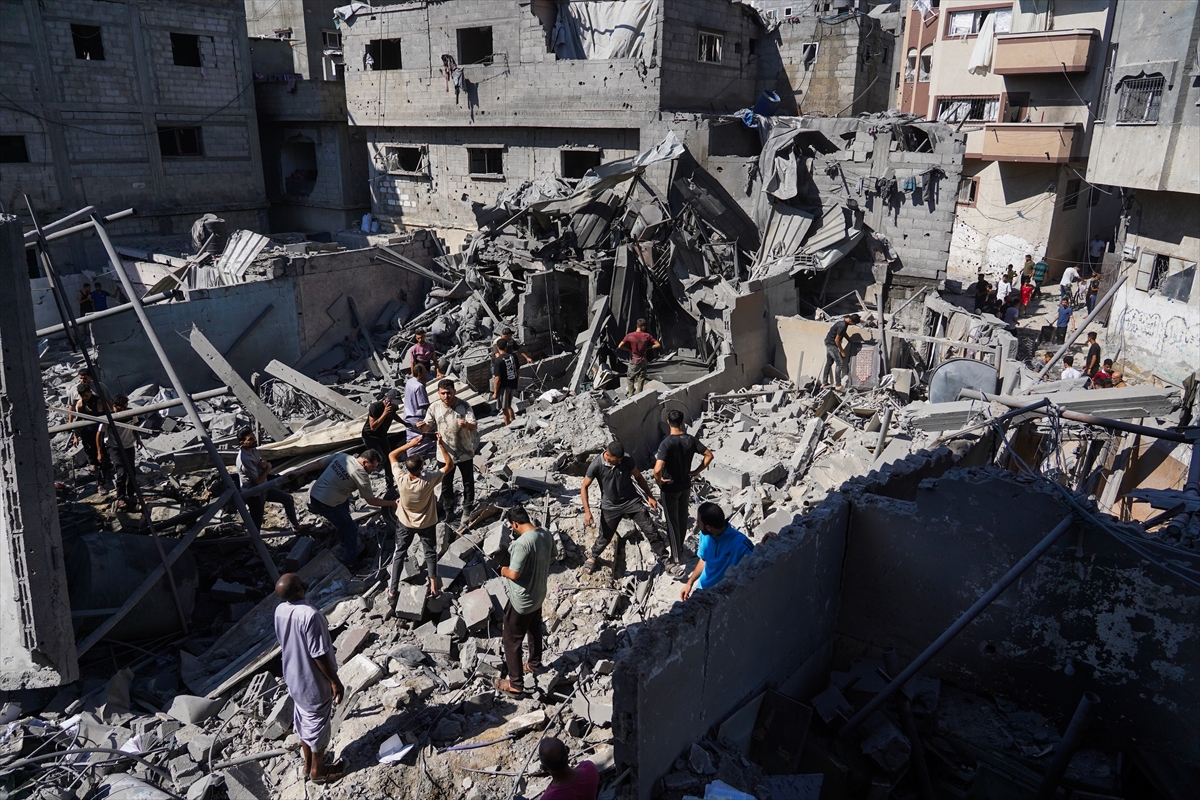
[Photo: Palestinians walks over the rubble after the Israeli army bombs a building in al-Bureij Refugee Camp in the central Gaza Strip, following an evacuation warning issued for the building, in Gaza, Palestine, on September 8, 2026. Photojournalist: Adam Bilal/AA]