By Elham Asaad Buaras
LONDON, (The Muslim News): Abdul El-Sayed has become the first Muslim elected to the US Senate, declaring that “America is big enough for all of us” after defeating Republican Mike Rogers in Michigan. His victory speech challenged the Islamophobic attacks directed at him during the campaign, as Muslim candidates secured gains in Congress and state legislatures across the country.
El-Sayed’s victory comes on the first anniversary of Zohran Mamdani’s election as New York City’s first Muslim mayor, marking another milestone for Muslim political representation in the United States
The 42-year-old Democrat, the son of Egyptian immigrants and a former public health official, faced repeated attacks from President Donald Trump and Republican allies over his Muslim faith, Arab heritage and opposition to US military assistance to Israel.
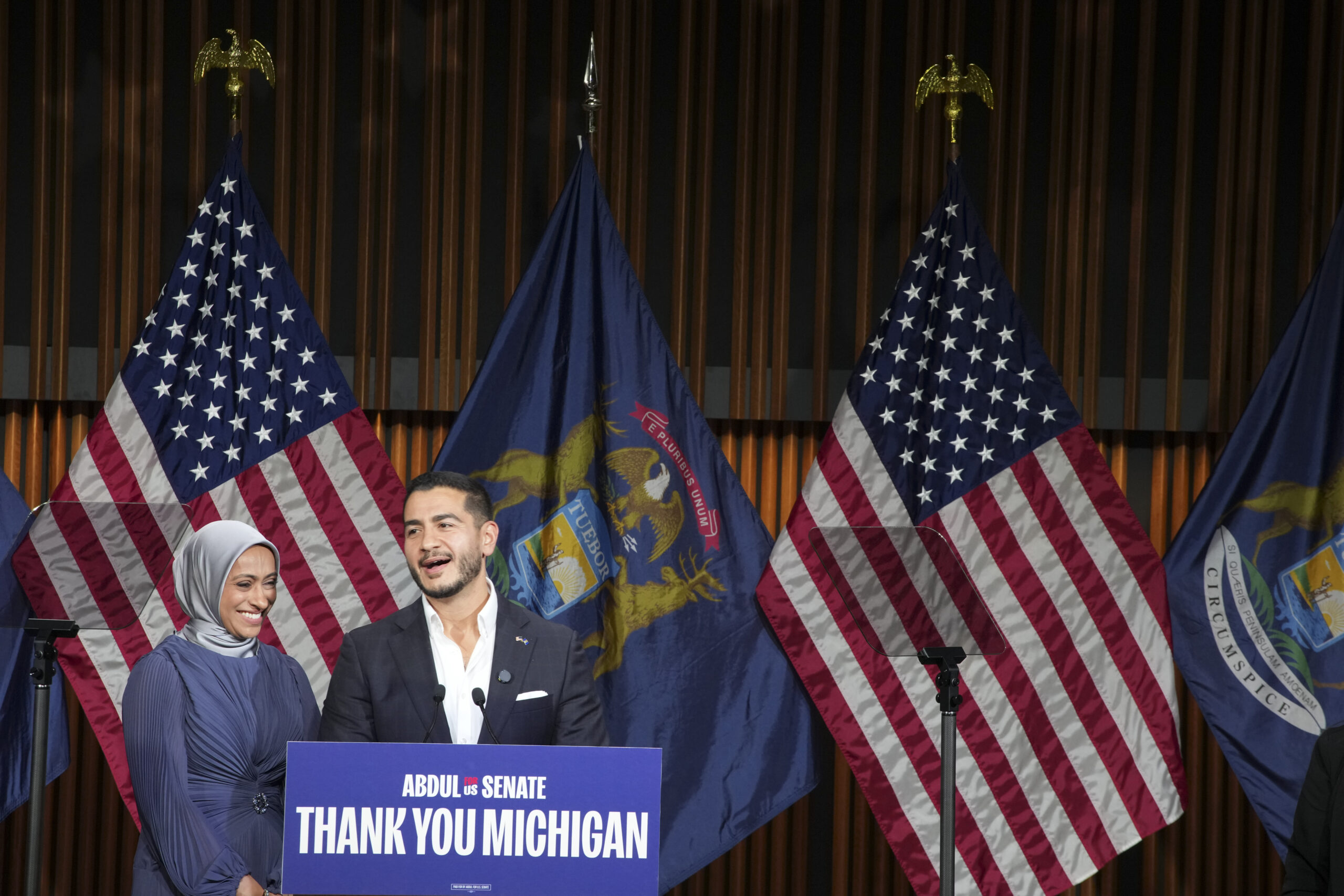
Addressing supporters in Detroit in the early hours of Wednesday, November 4, El-Sayed said his opponents had focused on his name and religion rather than voters’ economic concerns.
“They want an America that is too small for some of us,” he said. “We know that America is big enough for all of us.”
Taking aim at Rogers, he added: “You chose hate, and Michigan chose hope. May we never have to see the likes of you in this state again.”
He also mocked Trump’s repeated mispronunciation of his name, telling the President: “Donald, I know you struggle with my name, so after JD swears me in in January, you can go on and call me Senator.”
He thanked supporters for welcoming him into their homes and places of worship.
“You welcomed me in your homes, your churches, your synagogues,” he said, reflecting on the movement built during 18 months of campaigning across Michigan.
El-Sayed’s election breaks a historic barrier in a Senate that has never had a Muslim member. It also coincides with Democrats regaining control of both chambers of Congress, ending Republican control of the legislature.
Turning to foreign policy, he said: “We want our taxes spent here, for schools here, and healthcare here, and infrastructure here. We don’t want our money sent to do apartheid, or genocide, or war.”
His campaign called for publicly funded healthcare through Medicare for All, action on the cost of living and an end to unconditional US military assistance to Israel.
Islamophobic attacks fail to derail El-Sayed’s campaign
The race drew national attention after Democratic Senator Gary Peters announced his retirement, leaving an open seat Republicans hoped to capture.
Rogers, a former Congressman and FBI agent backed by Trump, campaigned as an ally of the president. Trump sought to portray El-Sayed as a national security threat, calling him a “jihadist” and alleging links to the Egyptian Muslim Brotherhood.
El-Sayed rejected the allegations, for which no supporting evidence was presented.
The attacks intensified after he defeated Congresswoman Haley Stevens in the Democratic Primary in August. The American Israel Public Affairs Committee (AIPAC), through its United Democracy Project super PAC, spent about $30 million opposing him during the primary, according to The Guardian.
The general election also attracted more than $220 million in advertising expenditure by mid-October, according to AdImpact.
El-Sayed’s opposition to unconditional US military assistance to Israel became a central campaign issue. He described Israel’s military operations in Gaza as genocide and called for US funds to be directed towards domestic priorities rather than wars overseas.
Stevens, his former Democratic primary rival, endorsed Rogers two days before the general election, criticising El-Sayed’s position on Israel.
Trump also sought to exploit divisions between Arab American and Black communities, describing Black and Jewish voters supporting El-Sayed as “crazy”. Early results, however, showed the Democrat performing strongly among Black voters in Detroit.
Maya Berry, Executive Director of the Arab American Institute, told Al Jazeera that the rejection of anti-Arab and anti-Muslim rhetoric had significance beyond Michigan.
“The electorate rejecting that bigotry is tremendous, I would argue, for every little boy named Abdul, every little girl named Zainab, every little kid named Bobby,” she said, referring to the wider implications for an inclusive democracy.
In neighbouring Dearborn, home to one of the largest Arab American communities in the US, polling stations experienced long queues on Election Day. Voters told Al Jazeera that the campaign against El-Sayed had encouraged greater political participation among Arab and Muslim Americans.
Reporting from Michigan on the eve of the election, Zeteo journalist Prem Thakker spoke to Muslim and Arab Americans about hostility towards their communities. His report, What About Arab and Muslim Safety?, documented fears that attacks on El-Sayed could fuel hostility towards people sharing his faith and background.
Muslim candidates break new ground in Congress
El-Sayed’s election was part of a wider breakthrough, with at least six Muslim candidates also winning seats in the House of Representatives, according to Anadolu Agency.
In New Jersey, Democrat Adam Hamawy won the 12th Congressional District, defeating Republican Gregg Mele to become the state’s first Muslim member of Congress.
Hamawy, 56, is an Egyptian-born plastic surgeon, retired US Army combat doctor and Iraq War veteran. He served as a military surgeon during the Iraq War and later undertook humanitarian medical missions in several countries, including Gaza in 2024.
His experience treating patients in conflict zones helped prompt his entry into politics. His campaign called for universal healthcare, cancellation of medical and student debt, an end to US military assistance to Israel and the abolition of Immigration and Customs Enforcement (ICE).
After winning the Democratic primary, he told supporters: “We made it clear you never need to ask for permission to fight for justice.”
According to The National, Hamawy is also the first person of Egyptian descent elected to the US House of Representatives.
In New York, Democrat Darializa Avila Chevalier won the 13th Congressional District, defeating Republican Jomo Williams after ousting long-serving incumbent Adriano Espaillat in the Democratic primary.
A civil rights investigator and doctoral student who converted to Islam, she secured 87.4 per cent of the general-election vote, according to results reported by Ballotpedia.
Four Muslim incumbents were also re-elected.
Palestinian American Rashida Tlaib won a fifth term representing Michigan’s 12th Congressional District, while Ilhan Omar secured a fifth term in Minnesota’s 5th District.
André Carson retained his seat in Indiana’s 7th Congressional District, while Lateefah Simon was re-elected in California’s 12th District.
Muslim voters mobilise as political representation grows
The Council on American-Islamic Relations (CAIR) tracked more than 160 Muslim candidates standing for local, state and federal office during the 2026 election cycle and ran a non-partisan voter mobilisation campaign.
Through its Get Out the Vote campaign, CAIR reported 500,198 text messages sent to 250,099 Muslim voters across 10 states, alongside 1.29 million impressions on Meta platforms, including Facebook and Instagram, and 321,500 on streaming television. The combined total of more than 2.1 million includes repeated contacts and advertising views, not unique voters.
By November 1, CAIR and research partner Molitico estimated that 88,148 people on its outreach list – 35.2 per cent of those contacted – had voted early or by post.
In six states where historical voting records were available, 49,217 people on the list had cast early or postal ballots, compared with 39,694 across the entire 2022 midterm elections – an increase of 24 per cent.
A CAIR survey of 861 Muslim respondents, released on October 28, found that 81 per cent intended to vote and nine per cent probably would. Among respondents who did not vote in 2022, 74 per cent said they intended to participate in 2026. The figures reflect stated intentions, not actual national Muslim turnout.
CAIR and its advocacy affiliate, CAIR Action, scheduled a November 4 news conference to release their Muslim voter exit poll, covering turnout, party preferences and key concerns, including the cost of living, inflation, Gaza, the US-Israel war on Iran and anti-Muslim hostility.
CAIR’s August directory identified 255 Muslim elected officials across 26 states, including 46 state legislators, 11 mayors and 18 elected judges. Women accounted for 110. The latest results add to that representation, with Muslim candidates elected to the Senate, House of Representatives and state legislatures.
Muslim women make their mark in state politics
Two Muslim women won state Senate seats, strengthening Muslim and Palestinian American representation in state politics.
In Illinois, 27-year-old Nabeela Syed, whose parents immigrated to the US from Hyderabad, India, in the 1980s, defeated Republican incumbent Darby Hills in the 26th State Senate District.
Elected to the Illinois House in 2022 at the age of 23, shortly after graduating from university, Syed was re-elected in 2024 before winning a seat in the state Senate.
She won 57 per cent of the vote to Hills’ 43 per cent, flipping the Republican-held seat, according to The National.
In 2022, Syed told NBC News that Trump’s first election victory had made her question whether the US was a place for people like her.
“It’s important for me, growing up in this community and knowing what it feels like to not belong, to make sure everyone feels like they do belong,” she said.
In New York, Palestinian American community organiser Aber Kawas won the 12th State Senate District, defeating Republican Han-Khon To. She represents parts of western Queens, including Astoria, Long Island City, Sunnyside, Woodside and Jackson Heights.
Kawas is the first Palestinian American elected to the New York State Legislature and the first hijab-wearing woman to serve there.
Unofficial New York State Board of Elections results showed her winning 70.13 per cent of the vote, with 47,291 votes, against To’s 23.97 per cent.
She celebrated the result on social media, writing: “We made history.”
Women and minorities break new ground across the US
The midterms also brought historic breakthroughs for women and minority communities across the country.
In Georgia, Democrat Keisha Lance Bottoms became the first Black woman elected governor in US history, defeating Republican businessman Rick Jackson. The former Atlanta mayor’s victory returned the governorship to Democratic hands for the first time since 1998.
In New Mexico, Democrat Deb Haaland became the first Native American woman elected governor. A member of the Laguna Pueblo, she previously served as interior secretary under President Joe Biden and was one of the first two Native American women elected to Congress in 2018.
In Florida, Republican Byron Donalds became the state’s first Black governor and the first Black Republican elected governor in the US.
In Texas, Democrat Gina Hinojosa defeated Republican incumbent Greg Abbott to become the state’s first Latina governor and its first Democratic governor since Ann Richards left office in 1995.
In Ohio, Democrat Amy Acton became the state’s first woman governor, defeating Republican Vivek Ramaswamy.
Illinois Democrat Juliana Stratton’s election means three Black women will serve in the Senate simultaneously for the first time, alongside Angela Alsobrooks of Maryland and Lisa Blunt Rochester of Delaware.
The Senate also gained its first Native American woman, with Democrat Peggy Flanagan winning election in Minnesota.
Jeffries poised to make history as first Black House Speaker
Democratic House leader Hakeem Jeffries is poised to become the first Black Speaker of the House after his party regained control of the chamber.
Democrats secured at least 219 seats in the 435-member House, giving them a majority.
Jeffries, who has represented New York in Congress since 2013, must be formally elected by fellow lawmakers when the new Congress convenes in January 2027. His election would make him the first Black American to hold the position, which ranks second in the presidential line of succession.
Control of both chambers will allow Democrats to block legislation, scrutinise the administration and investigate its policies, although Trump retains his veto.
[Photo: Abdul el-Sayed, the Democrats’ Muslim candidate in the state of Michigan in the U.S. congressional midterm elections, declared victory in a speech addressed to his supporters, saying ‘Michigan, we did it. I am proud and honored to stand before you as this state’s senator-elect.’ Abdul el-Sayed was also joined on stage by his wife, Dr Sarah Jukaku. Photographer Katie McTierman/AA]