By Iqbaal Abdi
London, (The Muslim News): Somalia has begun strengthening its diplomatic ties with regional allies after Israel’s illegal recognition of Somaliland, breakaway region of North Somalia. On December 26, during a call between Israeli Prime Minister, Benjamin Netanyahu, and Somaliland President, Abdirahman Mohamed Abdullahi (Cirro), Netanyahu announced Israel has officially recognised the state of Somaliland, making it the first UN member state to do so.
Netanyahu stated that Israel would work together with Somaliland in the economic, agricultural, and social development fields before concluding that he would “communicate with President Trump on your [Somaliland] willingness and desire to join the Abraham Accords.”
Following the announcement, President Hassan Sheikh Mohamud of Somalia spoke to Al-Jazeera in an exclusive interview.
Mohamud explained that “Three important steps have been agreed with Somaliland. Number one is the relocation of Palestinians to the territory, number two is providing a military base to Israel on the Gulf of Aden coast, and number three is for Somaliland to join the Abraham Accords. Mohamud stated that if all three are implemented by Somaliland, it will open a ‘Pandora’s box’ in the Horn of Africa.”
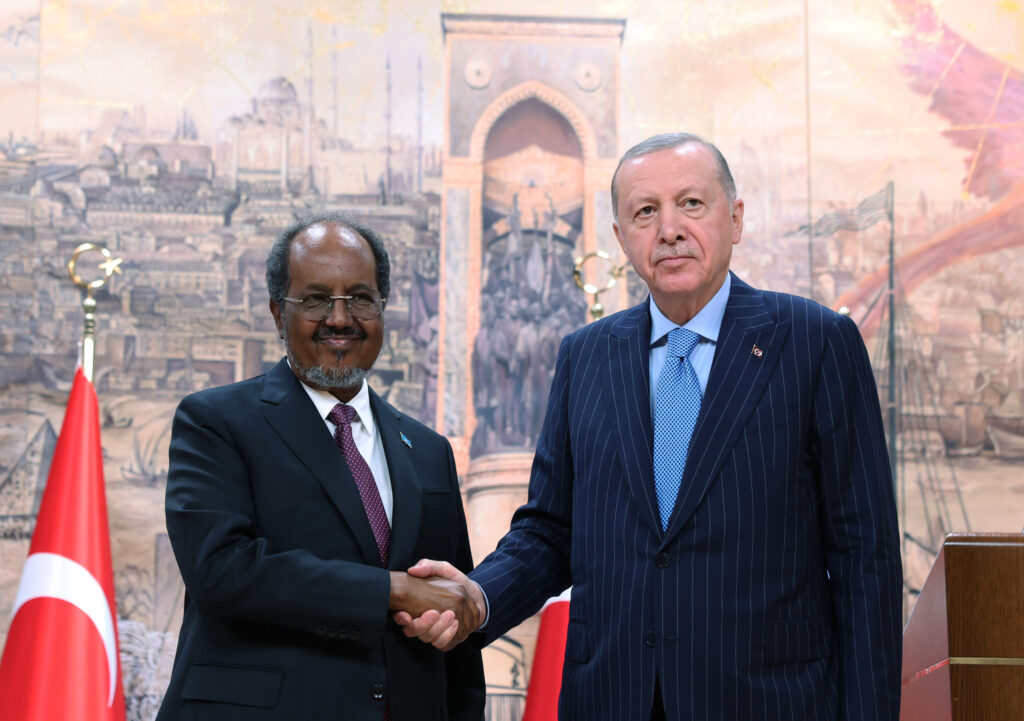
The interview took place during Mohamud’s official visit to Ankara, where he met with Turkish President Recep Erdogan.
In a press conference with the two leaders, Erdogan reassured Mohamud that Türkiye would “continue to resolutely support Somalia’s territorial integrity and political unity and stand with the Somali people.”
After paying a visit to Türkiye, Mohamud is now expected to visit Saudi Arabia in the following days following an invitation from the King.
In the Arab world, the declaration of Somaliland’s independence by Israel was met with strong condemnation by members. The Arab League Council met in Cairo, Egypt, on December 28 and reaffirmed the Arab position that Somaliland is part of the Federal Republic of Somalia. The council also rejected any attempt by Israel to forcefully displace Palestinians to Somaliland or that the coast would be used to establish Israeli military bases.
The Organisation of the Islamic Conference, the African Union, and the European Union also rejected the recognition of Somaliland by Israel, calling for respect for Somalia’s territorial sovereignty.
21 African, Arab, and Islamic states issued a joint condemnation over Israel’s move.
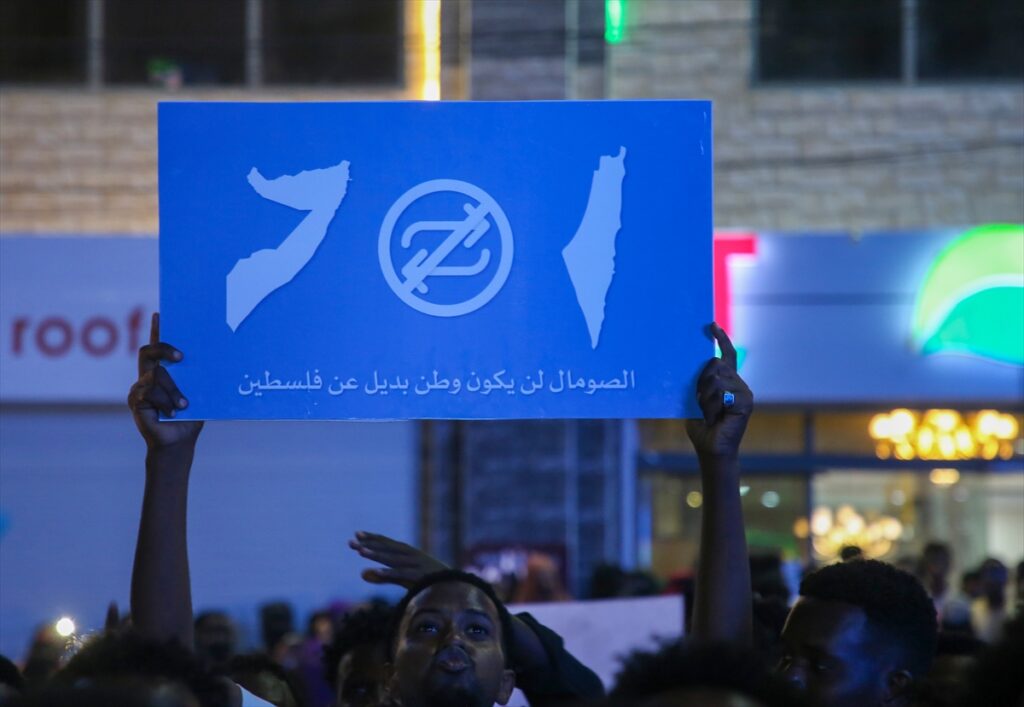
[Photo: A group of Somalis, carrying Somali flags, “Somalia won’t be a replacement for Palestine” and chanting slogans against Israeli Prime Minister Benjamin Netanyahu and Israel, protest at Israel’s decision to recognize Somaliland, gathering in Mogadishu, the capital of Somalia, on December 28, 2025.]
Somalia continued to appeal to international institutions after Israel’s move. Somalia, which serves as a non-permanent member of the United Nations Security Council (UNSC), held an emergency meeting on the issue of Israel’s recognition of Somaliland. Somali representative Abukar Osman accused Israel of committing a flagrant assault on the unity and territorial integrity of Somalia, which he said violated the UN charter.
Overwhelmingly, the UNSC member states condemned Israel’s action, with the exception of the U.S., which attempted to draw similarities between Israel’s recognition of Somaliland and recognition of Palestine but did not change its position in regard to the region.
However, Israel’s actions have not yet been condemned by neighbouring state Ethiopia. Ethiopia in recent years has challenged Somalia’s territorial integrity when, on January 1, 2024, it signed a Memorandum of Understanding with Somaliland, bypassing Mogadishu. In the deal, Somaliland agreed to grant Ethiopia access to the sea in exchange for recognition. In the aftermath, Somalia cut off all diplomatic relations with Ethiopia but came to an agreement after Türkiye mediated between the two neighbouring nations.
In addition, the UAE has taken a positive stance towards Israel’s recognition of Somaliland. In an unconfirmed report, the UAE official e-channels for visa and residency now list the Republic of Somaliland separately from Somalia.
What is Somaliland?
British Somaliland
The land that Somalis inhabit in the Horn of Africa was divided into five regions during the scramble for Africa. In modern-day Djibouti, it was named French Somaliland and came under the French empire. North Somalia (modern-day Somaliland), called British Somaliland, came under the British empire. The rest of Somalia was under Italian rule. The western region, the modern-day Somali region of Ethiopia, was ceded to the emperor of Ethiopia by Britain. Lastly, modern-day Northern Kenya (Northern Frontier District) was under British rule but joined Kenya after independence.
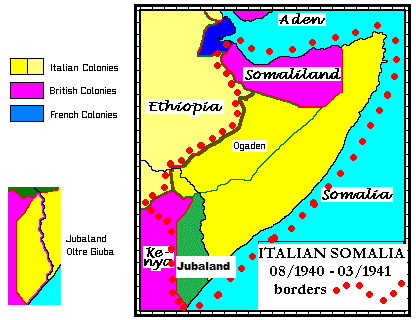
[Map of Italian Somalia after the conquest of British Somaliland (in August 1940) and areas around Moyale/Buna in Kenya (in July 1940). Within the green line is Ogaden, annexed from Ethiopia in 1936. The red dotted line encircles Mussolini’s “Grande Somalia”, that lasted from August 1940 to March 1941 under governor De Simone. [Source: Duilmodena/Wikimedia/CC]
Today, the Somali region of Ethiopia is under Ethiopian rule after a failed attempt in 1977 by Siad Barre to fight off the imperial power. French Somaliland, which is inhabited by Somalis as well as the neighbouring ethnic group, the Afar, formed Djibouti after gaining independence in 1970.
Somalia was thus formed from two of the five pre-colonial territories of Somalis — British and Italian Somaliland. With the fall of Benito Mussolini, Italian Somaliland became a UN trust territory, forming a 10-year transitional government led by Abdullahi Isse. After a decade of self-governance in Italian Somaliland, a date towards independence was set. Britain gave British Somaliland the option of unifying with their Southern counterparts. On June 26, 1960, British Somaliland gained independence, unifying with Italian Somaliland on July 1 and thus forming the Somali Republic.
Modern-day Somaliland
In 1991, after the collapse of the Siad Barre regime, Somaliland declared itself an independent state. Siad Barre came to power in 1969 through a successful military coup and committed atrocities against numerous clans in Somalia. Amongst these atrocities was his campaign in 1988 against the Isaaq clan, who are largely separatists today and form the vast majority of the secessionists in Northern Somalia.
Somaliland appeals to the colonial borders of British Somaliland to reflect its own borders today. However, Somaliland suffers from internal conflicts within its self-declared territory. The Sool, Sanaag, and Cayn region (SSC), also referred to as Khatumo in Northeast Somalia/East Somaliland, is unionist. In April 2025, after conflict broke out between Somaliland forces and unionists, Somaliland was repelled from large swaths of SSC, leading to the recognition of the state of SSC by the Federal Republic of Somalia. Consequently, Somaliland controls only half of its previous colonial territory. To further matters, the northwest region of Somaliland, Awdal, continues to experience tensions between unionists and separatists.
Thus, Somaliland’s claim of being a stable democratic country with clear sovereignty is a misrepresentation of its own reality. Although Somaliland does not have the presence of Al-Shabaab, Somaliland has a dominant clan, which in itself experiences internal sub-clan divisions. These divisions led to conflicts in Hargeisa in 1994. Tensions also rose again during the extension of former President Muse Bihi’s term in 2022. Moreover, Somaliland’s oppressive approach towards unionists in the SSC and Awdal region further highlights that Somaliland suffers from its own instability and democratic decadence.
Deputy Permanent representative of Israel to the UN, Jonathan Miller stated Somaliland met the criteria for statehood during the UNSC meeting on January 29. He explained Somaliland had a permanent population with a ‘defined territory’. However, Miller’s argument ignores the full and complex relationship between Somaliland and SSC/ Awdal.
Why has Israel recognized Somaliland?
Displacing Palestinians out of Gaza
In February 2025, U.S. President, Donald Trump, announced his plan for the U.S. to ‘take over’ the Gaza Strip and displace the Palestinians to elsewhere — an idea welcomed strongly by Netanyahu. Under Trump’s plan, Somalia was considered amongst other African countries such as Sudan and Morocco. More specifically, Somaliland was under strong consideration as a potential destination to displace Palestinians to. When Trump was asked whether he would consider the recognition of Somaliland if it were to accept Palestinians, Trump replied that he was “working on that”. Although Somaliland has denied it would accept resettlement of Palestinians, officials have welcomed Trump’s considerations.
The Red Sea and Bab Al Mandeb
Somaliland’s location on the Gulf of Aden provides close access to the Bab Al Mandeb — one of two chokepoints in the Red Sea. This global trade route has significant geopolitical consequences. According to a Swiss think tank, freights passing through the Red Sea are responsible for 15% of global trade, 20% of container traffic, 12% of seaborne oil, 8% of liquified natural gas (LNG), and nearly 17% of global internet data through submarine cables.
During the Ansar Allah (Houthi) attack on ships from Israel at the Bab Al Mandab, freight companies rerouted to Southern Africa, passing the Cape of Good Hope. On average, this added 10 days to shipment times and a cost of $1 million per voyage, hence, there would be an economic benefit for Israel if it were to gain a foothold on the Gulf of Aden.
Currently, there are confirmed reports that there is military cooperation between the United Arab Emirates (UAE), who have already established a base in Somaliland, and Israel. The UAE and Israel have launched intelligence-sharing initiatives such as Crystal Ball and have invested in the sharing of military technology. As part of this new cooperation between the two states, the UAE has facilitated Israeli access to the Arabian Peninsula and the Horn of Africa through the Socotra archipelago of Yemen and existing Emirati presence in the Somaliland and Puntland regions of Somalia.
According to Middle East Eye, “Military bases, runways, and other facilities have been constructed on Abd al-Kuri and Samhah, two islands that are part of the Socotra archipelago, which is now administered by the Southern Transitional Council; at the airports of Bosaso and Berbera in Puntland and Somaliland; Mocha in Yemen; and Mayun, a volcanic island in the Bab al Mandab strait.”
The report detailed that intelligence officers from both Israel and the UAE had arrived on the islands in 2020 and again in 2021 before the construction of airbases began in 2022.
Satellite images observed by the Middle East Eye show other islands in Socotra, including the Island of Socotra, Samhah, and Mayun (Perim), forming a network of bases.
Likewise, in Berbera, a port city in Somaliland, the UAE has developed facilities with a “modern military port, a deep-water dock, and an airstrip… meaning it can receive heavy transport aircraft and fighter jets.”
The UAE has also developed a base in Bosaso, Puntland, Somalia, where they have developed radar systems to track and monitor activities in the Gulf of Aden.
Although how beneficial the UAE bases in the Gulf of Aden are to Israel is unknown, it is in the Israeli interest to develop a presence in the Red Sea region for its strategy against the Houthis — whereby North Somalia and Socotra serve as a military base. In addition, creating a network of monitoring facilities along the Bab Al-Mandeb means control over what passes through. This creates domination over Israel’s enemy shipments such as those from Iran into the region but can also be used to leverage against regional Red Sea states such as Saudi Arabia and Egypt, who have a large economic reliance on the Suez Canal.
The UAE’s funding of the STC, who have governed Socotra against the internationally recognized government of Yemen, enables the construction of these bases against Yemen’s national interest. The UAE is thus exploiting secessionist movements in South Yemen, where the STC operates, and the secessionist movements in Somalia with Somaliland (and to a degree Puntland) to gain a military advantage in the region, which by extension benefits Israel.
Iqbaal Abdi, Graduate in Politics & International Relation
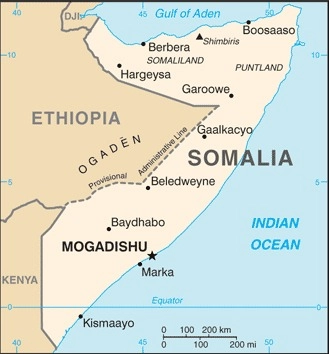
[Map of Somalia by CIA, US Government]